Site types
Create a site type and decide what the sites built from it offer.
Every site is built from a site type. A type is configuration: it deploys with the rest of your configuration. The sites themselves are content, created on each environment.
What a type decides
The type form holds a settings matrix: one row per setting, grouped under the section the setting belongs to, like Site information, Appearance or Assignable content. Each row has four columns:
| Column | Effect when checked |
|---|---|
| Default | The type gives the setting a default value, entered under Default settings below the matrix. Unchecked, the module's own default applies. |
| Available | Sites of the type show the setting and can change it. Unchecked, every site uses the default and the setting is hidden from its sections. A checked, disabled box marks a setting every site needs. |
| Environment overrides | The value can differ per environment. |
| Translatable | The value can differ per language. |
A ❌ marks a column the setting does not support. How these layers combine is on Setting layers; every setting is listed in the settings reference.
Two groups of rows decide what the sites hold and who works on them:
- Assignable content: one row per content type, like Content: Article, Taxonomy term: Tags or User. The value is Unlimited sites, Single site or Not assignable: how many sites one item of that type can belong to. Without a default from the type, taxonomy terms belong to a single site and everything else to unlimited sites. See Content on sites.
- Assignable roles: one row per role. A role the type offers can be granted on its sites, on one site at a time. See Roles and permissions.
A changed default applies at once to every site of the type that has no value of its own for that setting.
Create a site type
Before you start
You need the Administer sites configuration permission.
Steps
- Go to Sites configuration > Site types (
/admin/sites/types). - Click Add site type.
- Enter a Label. The machine name follows it and cannot change later.
- Enter a Description. It is shown when someone chooses a type on Add site.
- Select the Base site plugin: Content site for sites created and managed in the admin UI. It cannot change later.
- In the matrix, check Default on each row the type should preset, then enter the values under Default settings.
- Set Available, Environment overrides and Translatable per row.
- Click Save.
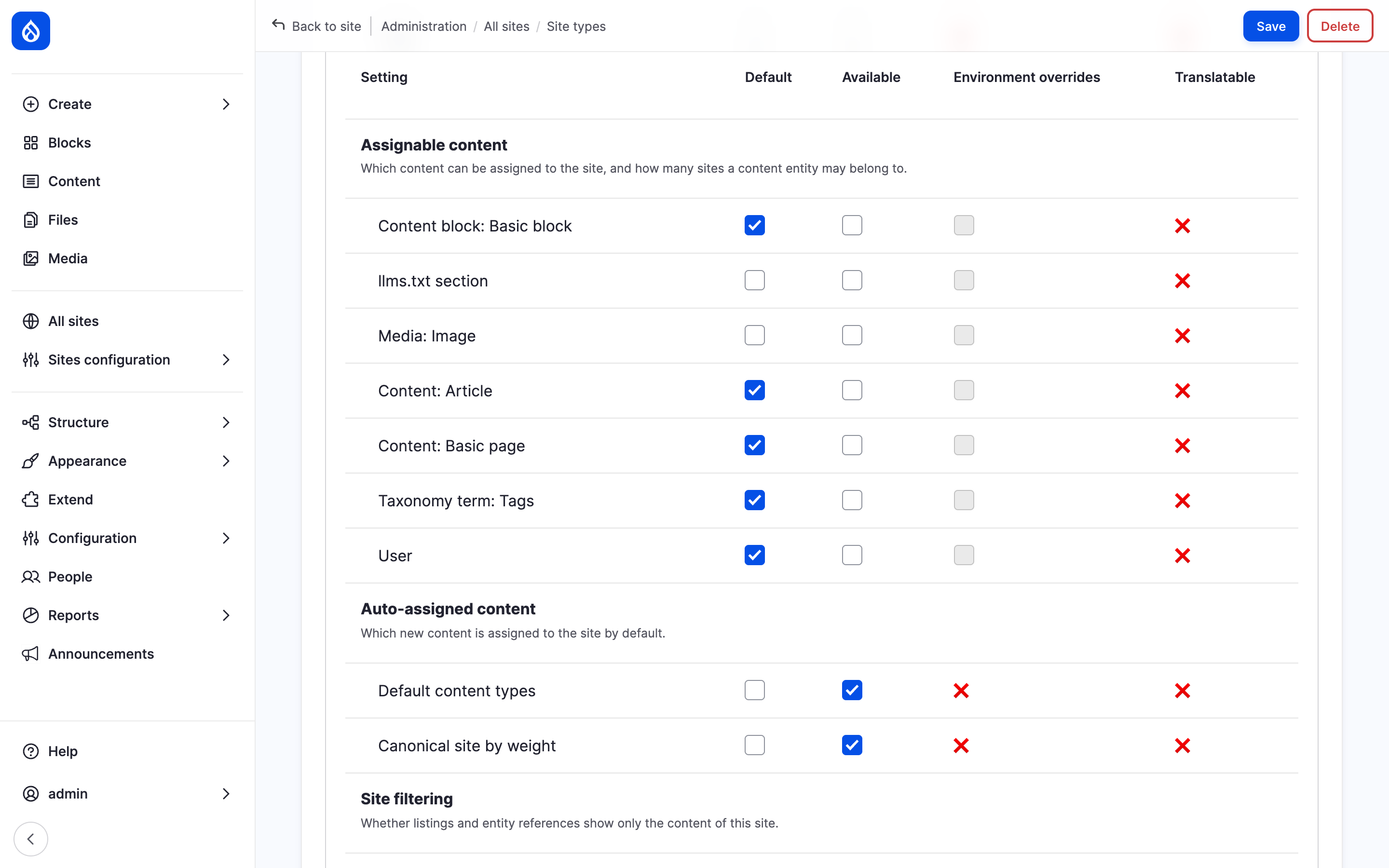
The settings matrix of a site type at the Assignable content rows.
The list at /admin/sites/types shows each type's label, machine name and
base plugin. Edit changes a type. Delete works only while no site uses
the type.
An install without a site type
The modules alone create no site type. Until one exists, Add site
(/admin/sites/add-site) shows "No site type exists yet." with a link to add
one, and no site can be created. The hub and its administration work as
usual. The Content sites recipe adds a type named Site; see
Installation.