Is it a deep fake?
Every label the module shows on media depends on one answer: the "What is it?" question, set to "deep fake" or not. The definition is broader than editors tend to expect, and a wrong "no" leaves the content unlabelled. On media forms the widget therefore shows this guide next to the question, open by default.
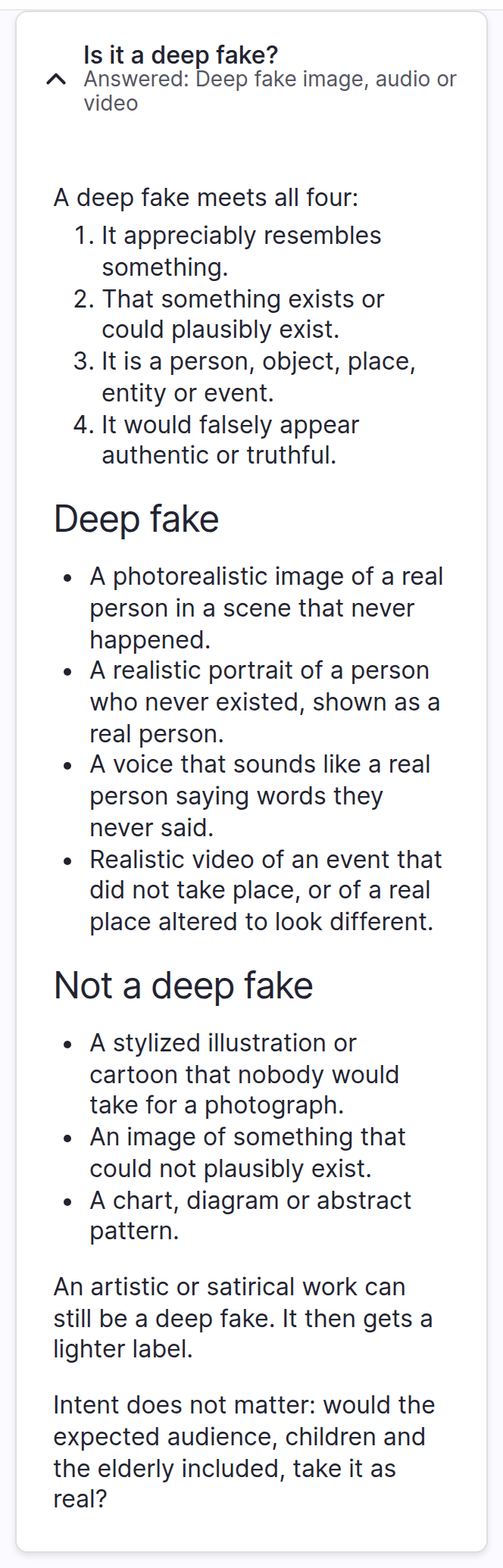
The four criteria
Article 3(60) of the AI Act defines the term, and the Commission guidelines (C(2026) 5054) read the definition as four cumulative criteria. All four must hold:
- The content appreciably resembles something.
- That something exists or could plausibly exist.
- It is a person, object, place, entity or event.
- It would falsely appear authentic or truthful.
If one fails, the content does not qualify.
Things editors often get wrong
Five points come up again and again in practice.
A person who never existed counts. Content that exists, can plausibly exist or could have plausibly existed is enough (paragraph 113 of the guidelines). A realistic portrait of an invented person is in scope when it is shown as a real one.
Photorealism is a hint, not a test. It makes the case more likely but does not decide the question alone.
Intent does not matter. Nobody has to mean to deceive. The test is whether the foreseeable audience would take the content as authentic.
That audience includes children and the elderly. Ask what they would believe, not what you would.
Art can still qualify. A manifestly artistic, creative, satirical or fictional work is answered in the next question, "Artistic work?". If the answer is yes the label stays, in its lighter form.
Examples
Images
In scope:
- A photorealistic image of a real person in a scene that never happened.
- A realistic portrait of an invented person, shown as real.
- A real place altered to look different, realistically.
Out of scope:
- A stylized illustration or cartoon that nobody would mistake for a photograph.
- An image of something that could not plausibly exist.
- A chart, diagram or abstract pattern.
Video
In scope:
- Realistic video of an event that did not take place.
- Realistic footage of someone real doing or saying something they never did.
- A real place altered to look different, realistically.
Not covered:
- Clearly animated or cartoon footage.
- Footage of something that could not plausibly exist, such as a creature no viewer would take for real.
- An animated chart or abstract motion graphic.
Audio
In scope:
- A voice that sounds like a real person saying words they never said.
- A realistic recording of a conversation or an event that never happened.
Outside the definition:
- A clearly synthetic voice that nobody would mistake for human.
- Music or sound effects that imitate nothing that exists.
What the module does with the answer
The module only stores the editor's answer, and nothing else changes when the guide is shown. The stored values are the same as without it. The visible labels on media depend on this answer, so it is worth getting right.