Running evaluations
Three ways to run a target: the admin UI, the ai-eval:run Drush command, and a
scheduled CI job. All three execute the same run engine and write the same
result row. This page is for whoever operates the evals.
From the UI
The Dashboard target list at /admin/config/ai/ai-eval has a per-target Run
button. Open a test to use its workflow page, which also has a Run button and
a run history table with Started, Status, Progress, Errors,
Updated, and Actions columns. The result link for a completed attempt is
in Actions.
The run advances one question per HTTP request, so a hundred-question dataset is
a hundred small requests rather than one that times out. Progress and the error
count update on each poll. Execution is browser-driven in this version: closing
the page pauses the run, and opening the Dashboard or the test's workflow page
again picks it up where it left off. A run left paused longer than
run_stale_seconds is shown as Interrupted (see below). Server-side
execution is a follow-up, not part of this version.
A Cancel button stops the run cleanly. A
cancelled run is marked cancelled and writes no result row, so its partial
scores remain only on the run attempt and do not become a completed result.
An active run is shown as Interrupted when it has made no progress for the
configured run_stale_seconds interval, 300 seconds by default. Resume
continues that same attempt from its saved progress. Cancel abandons it.
After a cancelled, errored, or interrupted attempt, Start a new run runs
every example again. It can repeat provider calls and incur provider charges.
If a progress request throws, the attempt enters the error state and polling
stops. Retry starts a separate run. The last_error field records the
exception class and message, truncated to 1,024 characters, for the failed
attempt and supplies the error detail shown in the UI.
Two locks keep concurrent operators honest: a per-target lock at run start, and a per-run lock on each step. The same target cannot be started twice at once, and no question is graded twice.
stateDiagram-v2
    [*] --> pending: Run pressed
    pending --> running: first step
    running --> running: one question per poll
    running --> complete: last question graded
    running --> cancelled: Cancel pressed
    running --> error: run failed
    complete --> [*]: result row written
    cancelled --> [*]: no result row
Running from the UI needs the operate ai eval or administer ai eval
permission.
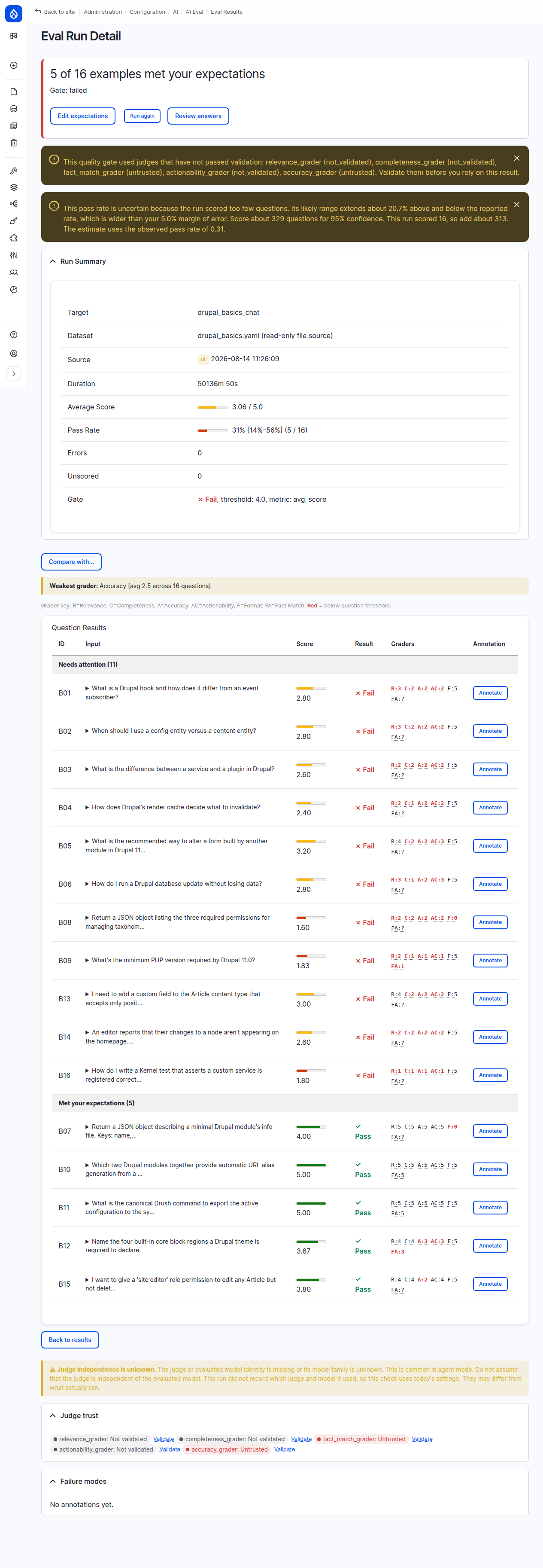
A result page leads with how many examples met your expectations, then the run summary and the per-example table with the failed examples first:
From Drush
The command is ai-eval:run, alias aer. With no options it runs every enabled
target.
# Every enabled target
drush ai-eval:run

# One target, or one question of one target
drush ai-eval:run --target=my_target
drush ai-eval:run --target=my_target --question=Q01

# List what would run, calling no provider
drush ai-eval:run --dry-run

# Also write a timestamped JSON results file
drush ai-eval:run --json

# Tag the run so cron runs are distinguishable from manual ones
drush ai-eval:run --source=cron

# Run every question as Drupal user 2
drush ai-eval:run --as-user=2
Options
| Option | Default | What it does |
|---|---|---|
--target |
all enabled targets | Run only this target id. An unknown id is an error that lists the available ids. |
--question |
all questions | Run only this question id. Skips the sample-size advisory, since the run is a single question. |
--split |
all |
Run only the train, validation, or test partition of the dataset. Any other value is an error. See datasets. |
--source |
manual |
The run source tag stored on the result row. |
--as-user |
none | The Drupal uid used as caller for every question. |
--dry-run |
off | List targets and question counts, then exit. Ignores --split, see below. |
--json |
off | Also write a JSON results file. |
Dry run
--dry-run resolves each target's dataset and prints the target id, the question
count, and the dataset reference. It calls no AI provider, grades nothing, and
writes no result row, so it costs nothing and is the cheap way to confirm that a
target points at the dataset you think it does.
$ drush ai-eval:run --dry-run
DRY RUN: would evaluate these targets:
  my_target: 24 questions from my_dataset.yml
Warning
--dry-run ignores --split. The dry-run branch loads and counts the
dataset before the split reaches the runner configuration, so
--dry-run --split=test reports the whole dataset, not the test partition.
The count it prints is the full question count in that case.
The JSON results file
--json writes one file per invocation, covering every target the run touched.
It goes to the results_path set in configuration, or to
the system temp directory plus /ai_eval_results when that setting is empty. The
filename is results-YYYYmmdd-HHMMSS.json and the payload is the run timestamp
plus one entry per target id. The path is printed at the end of the run.
This file is a raw dump of the run, not a portable artifact. For an artifact meant to travel between sites, see sharing results.
Tagging the run source
--source sets the source column on the result row, and nothing else. It
defaults to manual, the UI writes ui, and a scheduled job should pass
--source=cron. The tag is carried into exported envelopes as run_source, so
"did this number come from a nightly job or from someone pressing Run" stays
answerable after the fact.
Running as a specific user
--as-user=N sets the run's default caller uid. A question that carries its own
caller_uid keeps it, so the option is a default rather than an override.
Warning
The option only has an effect if a host module registers a
ai_eval.caller_context service implementing
Drupal\ai_eval\Service\CallerContextInterface. AI Eval declares that
dependency as optional and ships no implementation of its own. Without a host
implementation, the uid is resolved and then handed to nothing:
--as-user changes nothing about the run. It exists for sites whose agents
resolve user-scoped state (per-user memory, per-user access) and that wire up
the service themselves.
Advisories printed during a run
A run prints warnings that never change the verdict or the exit code:
- The dataset is below the sample-size floor. See scoring.
- The gate verdict rests on a judge that is untrusted, stale, or never validated. See judges.
- The judge shares a model family with the evaluated model, so the scores are not an independent measurement.
- The target runs in agent mode and no attached grader observed what the agent did, so every score is a reading of the response text. See graders.
Exit codes
| Code | Meaning |
|---|---|
0 |
Every hard gate passed, or the run was a dry run. |
1 |
A hard gate failed, or the command could not run: unknown target, no targets configured, an invalid --split, or a failed JSON write. |
A soft gate that misses its threshold logs a warning and leaves the exit code at
0. Which targets are hard and which are soft is a per-target setting, covered
in scoring.
With the refuse_unvalidated_judges setting on, a pass that rests on a judge
that has not passed validation is stored as a failed gate, so on a hard gate
the exit code is 1. The last line of the output names every gate that did
not pass and says whether it failed or its pass was not counted; it reads
All hard gates passed. only when every gate passed.
In CI
Because a failed hard gate exits 1, a scheduled pipeline job can gate on eval
health. AI Eval ships no cron integration on purpose: a full run can be hundreds
of LLM calls, and when to spend that belongs to site operations.
# .gitlab-ci.yml, run from a scheduled pipeline
ai_eval_nightly:
  stage: test
  rules:
    - if: $CI_PIPELINE_SOURCE == "schedule"
  script:
    - drush ai-eval:run --source=cron --target=my_target --json
  artifacts:
    when: always
    paths:
      - sites/default/files/ai-eval-results/
    expire_in: 30 days
Point the paths entry at whatever results_path you configured, and create the
schedule under CI/CD, Schedules in the project settings. A crontab line does the
same job on a host with no pipeline:
0 2 * * * cd /var/www/html && drush ai-eval:run --source=cron
Two things are worth adding to a pipeline that gates on eval results. Run
drush ai-eval:judges --json in the same job to record which judges were trusted
at the time, since an eval result is only as good as the judges behind it; see
judges. And export an envelope if you want the run's evidence to
outlive the pipeline log; see sharing results.