Rubrics and deterministic checks
A rubric is a named, versioned bundle of checks that many questions can share.
This page covers what a rubric holds, how a question attaches one, which check
kinds the runner actually executes, and which ones exist as contract vocabulary
for graders and other runners to consume. schema/rubric.schema.json and
schema/README.md are authoritative.
What a rubric is
A question's criteria says what a good answer looks like for that one question.
A rubric writes the same standard down once, versions it, and lets ten questions
point at it.
A rubric document carries five things:
| Field | Required | What it is |
|---|---|---|
id |
yes | Stable snake_case identifier, for example support_tone. |
version |
yes | Semver. A major bump asserts that scores from the old version are not comparable to scores from the new one. |
checks |
yes | An ordered list of at least one check. |
scoring |
yes | How the check outcomes combine, and the pass threshold for the numeric combine modes. |
applicable_bundles |
no | Which domain bundles the rubric is meaningful for. Empty means any. |
A label and a description are also carried: the label is the display name in
rubric lists, and the description tells an author what the rubric measures. The
schema accepts both alongside the five fields above.
# yaml-language-server: $schema=https://git.drupalcode.org/project/ai_eval/-/raw/1.0.x/schema/rubric.schema.json
id: support_tone
version: "1.0"
label: "Customer-support tone"
description: "The reply should acknowledge the problem and stay polite."
checks:
  - kind: must_contain_any
    values: ["sorry", "apologies", "apologize"]
scoring:
  combine: all_pass
Attaching a rubric
A rubric attaches to a question, with a rubric_ref. There is no
dataset-level attachment: a rubric applies to a whole dataset because every
question in it names the same ref, which is also what lets one dataset mix
standards.
questions:
  - id: Q01
    input: "A customer says their order never arrived. Reply to them."
    rubric_ref: rubric/support_tone@1.0
Both the rubric/ prefix and the @version are required. The version is what
pins a question to a particular revision of the standard, so an older result
stays honest about which wording produced it.
A ref resolves to an enabled rubric with that id and version. A question with
no rubric_ref, or one pointing at a ref that does not resolve, is graded
against its own prose criteria exactly as before.
What a resolved rubric does
Two independent things happen, and they are easy to confuse.
flowchart TD
    Q["Question with rubric_ref"]
    R["Resolved rubric"]
    TEXT["Check descriptions rendered<br/>as criteria text"]
    JUDGE["LLM judges<br/>read the merged criteria"]
    EXEC["rubric_checks grader<br/>executes checks that have an executor"]
    SCORE["Scores averaged with<br/>every other grader"]

    Q --> R
    R --> TEXT --> JUDGE --> SCORE
    R --> EXEC --> SCORE
The criteria merge always happens. At run time each check is rendered as a
line of plain criteria text and appended to whatever inline criteria the
question already had. That merged text is what the LLM judges read. A check's own
description is used when it has one; failing that, the contains kinds,
target_match, command, and score_delta render a stock sentence, and every
other kind renders nothing. Opaque machine fields such as regex flags, schema
refs, and judge model ids never leak into a judge prompt.
The checks are only executed if you ask for them. Deterministic execution is
the rubric_checks grader's job, and it runs only when that grader is selected on
the target. Attach it and the rubric's executable checks are run
against the response, combined per the rubric's scoring block, and the 0 to 1
combined score is scaled onto the grader's 0 to 5 scale. A question with no
executable checks scores NULL, which the scorer skips rather than counting as
zero.
Running both rubric_checks and LLM judges on the same rubric scores the rubric
twice, deliberately. They are two graders whose scores get averaged: one executes
the checks, the other reads them as prose.
Check kinds
Every kind shares the optional base fields id, description, and metadata.
Unknown fields on a check are rejected, so typos surface at validation.
The column that matters operationally is the last one. Runner-executable
means the rubric_checks grader can run the check and turn it into a score.
Everything else is schema-valid, is preserved intact, contributes its
description to the judge criteria, and is counted in the rubric verdict's
reason as not executable.
kind |
Required fields | Key options | Runner-executable |
|---|---|---|---|
must_contain_any |
values |
case_sensitive |
yes |
must_not_contain |
values |
case_sensitive |
yes |
regex |
patterns |
mode (any or all), flags |
yes |
target_match |
reference_path |
mode (exact, normalized, chrf), threshold |
yes |
composite |
rubric_ref |
weight via the parent's scoring.weights[id] |
yes |
json_schema |
one of schema_ref or schema |
no | |
php_lint |
wrapper, wrapper_template |
no | |
markdown_structure |
min_headings, max_heading_level, required_sections, no_h1, min_code_blocks, forbidden_patterns |
no | |
format |
format |
strict |
no |
fact_match |
source, threshold |
no | |
tool_usage |
source, match_args |
no | |
llm_judge |
judge_prompt_ref, judges, threshold |
aggregation |
no |
command |
command |
sandbox, setup, expect |
no |
score_delta |
tool, min_delta |
sandbox, baseline, guard_command |
no |
The kinds that run
must_contain_any, must_not_contain, and regex are substring and pattern
tests over the response text. Matching is multibyte-safe and case-insensitive
unless the check sets case_sensitive: true. A regex pattern is a PCRE body
without delimiters, so slashes need no escaping. An invalid pattern fails the
check loudly with the pattern in the reason; it is never a silent skip.
target_match compares the response against reference text named by a dot-path
into the question. The path must start at expected. or metadata., for example
expected.references, and may resolve to one string or an array of acceptable
variants, in which case the best variant wins. normalized is the default mode:
trim, collapse whitespace runs, case-fold, then compare. exact is strict
equality. chrf scores character n-gram similarity and reports the continuous
score, so a weighted combine sees 0.85 rather than a rounded pass or fail, while
the check's own pass verdict gates on threshold. Authoring errors fail loudly:
an unresolvable path, a non-scalar or empty reference, invalid UTF-8 on either
side, an unknown mode, and a threshold outside 0 to 1 all fail the check.
composite reuses another rubric as one check. The sub-rubric is resolved and
evaluated recursively, and its combined verdict becomes a single outcome. The
recursion is cycle-guarded and capped at depth 3; a missing ref, a cycle, an
over-deep chain, or a sub-rubric with nothing executable in it makes the composite
check itself non-executable rather than failing the run.
The kinds that do not run
Three groups, for three different reasons.
Consumed by graders instead. llm_judge is never executed as its own judge
call here. Its description folds into the criteria the LLM judges already read,
and those judges produce the score. Do not treat the skip as a bug.
tool_usage expresses a tool assertion as a rubric check, and no executor is
planned for it: the implemented form is case-level expected_tools, scored by
tool_usage_grader against the agent's own record of what it ran. See
datasets. format and fact_match overlap the same way with
format_grader and fact_match_grader, which read the question rather than the
rubric.
Executors pending. command and score_delta are execution oracles. They
need a sandbox harness, because a verification command must run inside the
declared sandbox and never on the host. Progress is tracked at
#3594701.
Not implemented yet. json_schema, php_lint, and markdown_structure are
part of the shared contract and validate, but no executor ships for them today.
Note
A rubric made entirely of non-executable checks is not an error and produces
no score from rubric_checks. Its text still reaches the judges. If you
expected a deterministic number and got a skip, check which kinds you used.
Combining checks
scoring.combine is required and takes one of six values.
combine |
Combined score | Passes when |
|---|---|---|
all_pass |
1.0 when every executed check passed, else 0.0 | every check passed |
any_pass |
1.0 when at least one passed, else 0.0 | at least one passed |
weighted_avg |
weighted mean of the check scores | the combined score meets scoring.threshold |
min |
lowest check score | the combined score meets scoring.threshold |
max |
highest check score | the combined score meets scoring.threshold |
median |
median check score | the combined score meets scoring.threshold |
scoring.threshold is a number between 0 and 1 and applies to the four numeric
modes only; omitting it defaults to 0.5. scoring.weights is keyed by check id,
and a check with no id or no listed weight counts as 1.0. Weights that sum to zero
score the rubric 0 and say so in the reason. The combined score is clamped to 0
through 1 before the verdict is computed.
Non-executable checks are excluded from the combine entirely rather than counted as failures. The verdict's reason names how many were skipped and which kinds they were, so a rubric that scored 1.0 on one of its five checks cannot read as a clean pass.
Authoring rubrics
Rubrics live as ai_eval_rubric content entities, at
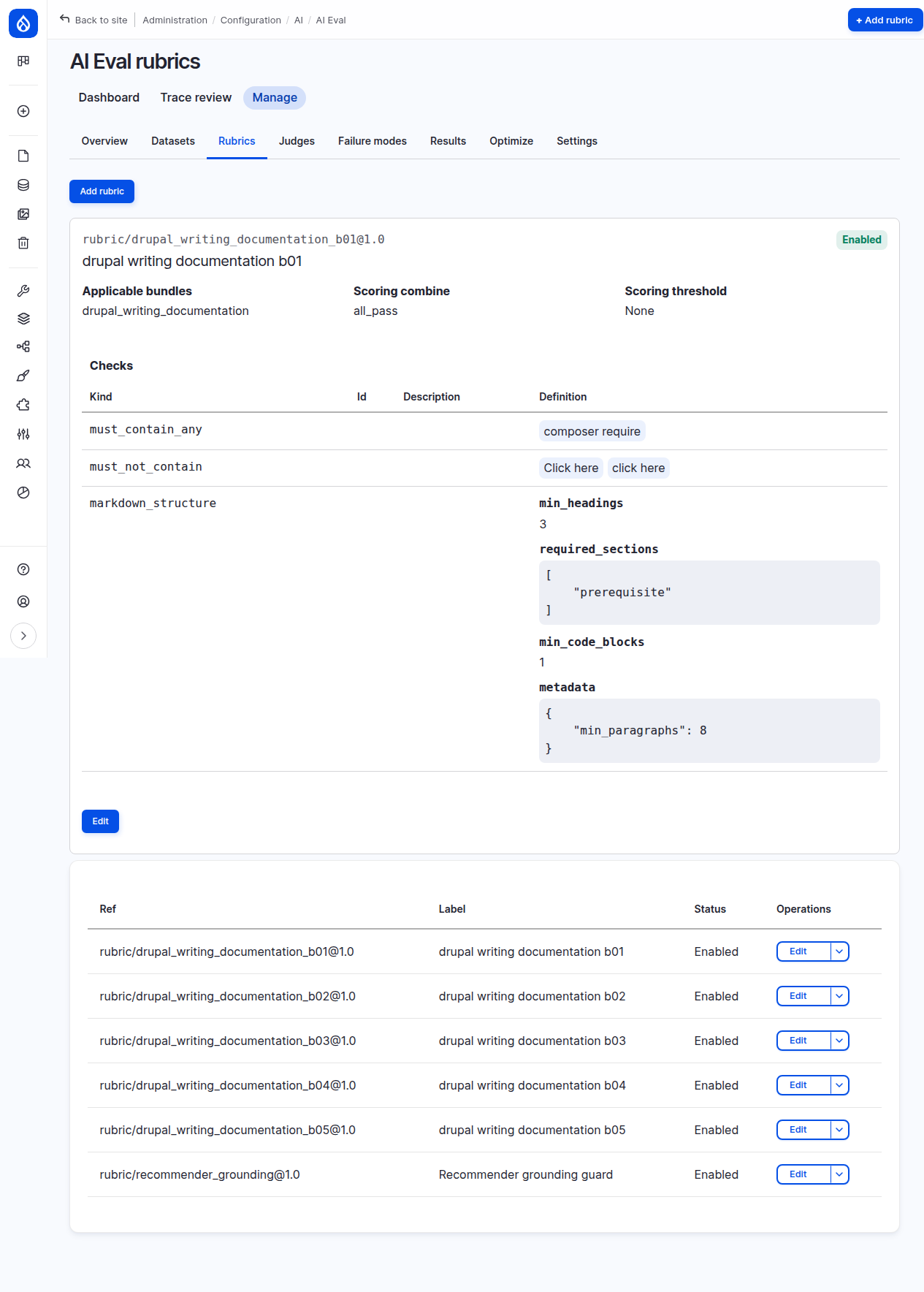
/admin/config/ai/ai-eval/rubrics under Manage > Rubrics. Add rubric opens
the inline editor, which covers the rubric id, version, label, description, the
enabled flag, the combine rule and threshold, the applicable bundles, and the
checks list.
Every rubric opens in the editor. The check editor gives two kinds dedicated form fields:
must_contain_any, which passes when the response contains any one of the values you list. Each value is a plain string, so a support-tone rubric might list "sorry", "apologize", "apologies".must_not_contain, which passes when the response contains none of them.
Every other kind is edited as JSON for the whole check. Its kind is fixed in
that row: when the kind property is present it must match the row, and when it
is omitted the editor adds the row's kind. Invalid JSON, non-object JSON, an
emptied textarea, and a different or invalid kind stay in the editor with an
error and are not saved; to drop a check, remove its row instead.
The JSON is also validated against the rubric schema on save. Show lists
the whole rubric, including every check field and structured values.
Disabling a rubric retires it without deleting it. A rubric_ref pointing at a
disabled rubric resolves to nothing, and the question falls back to its own
criteria.
Working examples
schema/examples/valid/ holds rubric fixtures that CI validates on every run:
rubric-all-pass.yaml, rubric-weighted-avg.yaml, rubric-composite.yaml,
rubric-target-match.yaml, rubric-llm-judge-single.yaml,
rubric-llm-judge-panel.yaml, rubric-command.yaml, rubric-score-delta.yaml,
and rubric-with-metadata.yaml.
Adding a check kind from your own module, so that it validates and executes without patching the schema, is covered in writing a check executor.