Modeler API
The Modeler API module provides a framework for building visual modelers in Drupal. It decouples the concept of what is being modeled (Model Owners) from how it is modeled (Modelers), and supports rich contextual metadata through four YAML-based plugin systems (Contexts, Dependencies, Template Tokens, Themes).
Who is this for?
This documentation targets Drupal module developers who want to:
- Integrate their configuration entities with a visual modeler (implement a Model Owner plugin).
- Build a new visual editing experience (implement a Modeler plugin).
- Provide contextual component lists, dependency rules, template tokens, or canvas styling for an existing model owner (define YAML plugins).
Key concepts
| Concept | Description |
|---|---|
| Model Owner | A plugin that owns config entities which can be visually modeled. It defines available components, how they are stored, and how the model is saved. Examples: ECA, AI Agents. |
| Modeler | A plugin that provides the visual editing UI. It knows how to render, parse, and serialize model data. Examples: BPMN.iO (XML/BPMN), Workflow Modeler (JSON/React Flow). |
| Context | A YAML-based plugin that defines which components are available for a specific use case within a model owner. |
| Dependency | A YAML-based plugin that constrains which components can follow other components. |
| Template Token | A YAML-based plugin that provides token trees for use in model templates. |
| Theme | A YAML-based plugin that points at asset libraries whose CSS overrides the styling of the modeler canvas. One theme can be selected per owner/modeler combination, or resolved automatically from the themes built for it. |
| Component | A value object representing a single element in a model (event, action, condition, gateway, etc.). |
Architecture at a glance
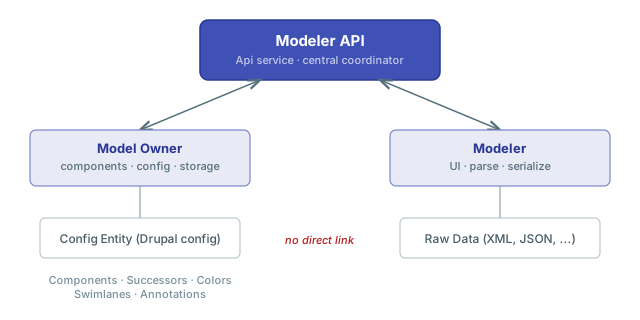
The Modeler API sits between Model Owners and Modelers as the sole mediator. Neither side has any knowledge of the other -- the Config Entity and Raw Data are completely isolated by the API's abstraction layer.
The Api service (modeler_api.service) acts as the central coordinator. It
exposes separate input/output interfaces for each side: ModelOwnerInterface
for Model Owners and ModelerInterface for Modelers. It manages the save
cycle (parse raw data, reset components, add components, finalize), and
exposes helpers for contexts, dependencies, export, and more.
Module requirements
- Drupal
^11.2 - PHP
>=8.3 - Optional:
drupal/tokenfor template token support.
Quick links
- Architecture Overview -- how all pieces fit together
- Plugin Managers -- detailed reference for each plugin type
- API Reference -- services, value objects, routing, schema
- Implementation Guide -- step-by-step guides with code examples